
Since the Bharatiya Janata Party (BJP) formed the government in West Bengal, the state has witnessed a sharp escalation in vigilante violence by Hindu nationalist organizations targeting Christians. These incidents have included raids on prayer meetings and churches, harassment and interrogation of worshippers, vandalism, physical assaults, and public humiliation, frequently justified through allegations of “religious conversion.”
Between May 13 and September 20, 2026, India Hate Lab (IHL) documented at least 60 incidents across 13 districts, including 52 raids on private prayer meetings, homes, churches, and other Christian gatherings, and eight incidents involving physical assault, mob violence, or vandalism. During the same period, IHL documented five public hate speech events explicitly targeting Christians, sometimes alongside Muslims, and three protests focused exclusively on alleged religious conversion.

The timing and rhetoric surrounding these incidents are significant. The documented surge began after the change in state government, and perpetrators have themselves invoked the BJP’s assumption of power while targeting Christians. In Panskura, Paschim Medinipur, on September 3, Vishwa Hindu Parishad (VHP) and Bajrang Dal members, while interrupting a Christian gathering at a rental guest house, warned that no conversion activities in “New Bengal” would be allowed, invoking Chief Minister Suvendu Adhikari’s public opposition to alleged religious conversion. In Barasat on July 12, members of Hindu Jagaran Manch, while threatening Auxilium Salesian Sisters over a private prayer cemetery, declared that their activities “would not be tolerated now that BJP is in power.”
Expanding Pattern
The incidents documented by IHL were distributed across 13 districts but showed notable geographic concentration. South 24 Parganas and Paschim Medinipur each recorded 13 raids on Christian prayer meetings. The organizations most frequently involved included Hindu Jagaran Manch/Bangiya Hindu Jagaran, Vishwa Hindu Parishad (VHP), Bajrang Dal, Hindu Suraksha Samiti, Hindu Ekta Manch, and Hindu Sanghati.
The raids follow a similar template. Local members of Hindu nationalist organizations entered private homes, churches, or rented venues where Christians were gathering for prayer, accused organizers of carrying out religious conversions, interrogated attendees about their religious identities, and, in several cases, demanded to inspect their Aadhaar cards. This pattern was documented in Chandrakona on May 13, May 20, and June 8; in Gosaba on May 28; in Basanti on June 6 (where six individuals were accused of conversion at a church); and in Canning on June 9.
In Sandeshkhali on July 8, VHP and BJP members entered a predominantly Christian neighborhood, while a Hindu monk demanded the residents show their Aadhaar cards, questioned why they left Hinduism, and termed Christianity a “legacy of the British rule.” In Hingalganj, Uttar Dinajpur, on August 30, Hindu Jagaran Manch members raided a prayer meeting, questioned an alleged Christian missionary from Argentina, and questioned why the Bible was being read instead of the Gita.
Gendered Harassment
A recurring feature of these incidents has been the targeting of Christian women over religious identity and traditional Bengali marital symbols. Women have been questioned about wearing sakha-pola, bangles traditionally worn by married Bengali Hindu women, and sindoor, and in several incidents were pressured to remove them.
In Ramnagar, Purba Medinipur, on September 5, Hindu nationalists told Christian women to remove their sakha-pola and mocked them for referring to Jesus as “Swami.” Similar incidents of harassment were recorded in Kulpi on September 6 and September 11.
On July 18 in Baruipur, a Hindu nationalist group followed and heckled a group of Christian women carrying Bibles and wearing sakha-pola and sindoor, calling them “sold out Hindus” and “bejaat Hindus”— a casteist slur accusing them of abandoning their caste and community by converting.
On September 19, in Barrackpore, VHP and Bajrang Dal members physically assaulted and publicly humiliated several Christian women, accusing them of facilitating religious conversion.
Physical Violence and Vandalism
Several raids escalated beyond intimidation into physical violence, mob attacks, or destruction of Christian religious property. On June 10, Hindu Jagaran Manch members vandalized a church in South 24 Parganas. In Subhashgram on July 5, Hindu nationalist supporters attacked a church under construction and broke down multiple crosses installed while chanting “Jai Shri Ram.” On August 25, a VHP and Bajrang Dal raid on a home in Magrahat turned violent. On the same day in Howrah, a mob detained two people accused of facilitating conversion, dragging them through the area to chants of “Jai Shri Ram.”
The mob stripped the man of his clothes and manhandled the woman in the presence of the police, who did not intervene, and later took the victims into custody. In Magrahat on September 7, a raid escalated into physical violence after members tore up Bibles and demanded that women remove marital symbols. Police arrested several attendees. In Kolkata, on September 11, Hindu Sanghati members targeted a prayer meeting and physically assaulted attendees. On September 19, VHP and Bajrang Dal members in Barrackpore tied up and assaulted several Christian women, accusing them of facilitating religious conversion.
Police Complicity
IHL documented a recurring pattern in which police were present during vigilante attacks and, in many cases, subsequently detained Christian attendees following allegations made by Hindu nationalist organizations.
In Raniganj on June 21, a mob led by VHP leader Shubham Raut assaulted attendees at a Sunday Prayer Meeting and handed over 20-25 attendees to the police, who launched an investigation over allegations of religious conversion. In Chaitanyapur, Haldia, on July 9, police accompanied Hindu nationalist supporters to detain two women distributing Christian religious literature.
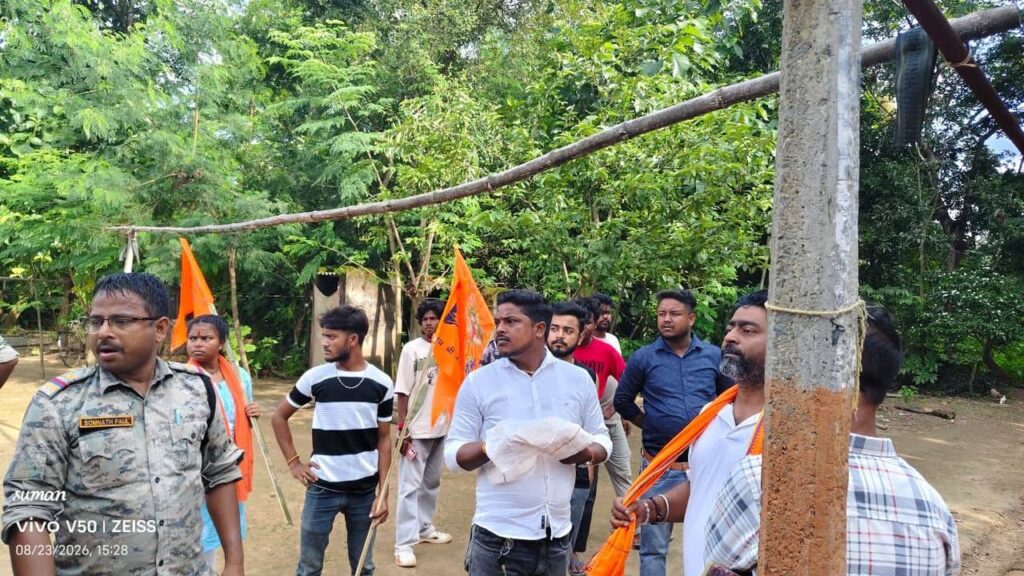
In Midnapore on July 6, police detained several individuals named by Hindu Jagaran Manch members in a complaint alleging conversion. In Purulia (July 5), Hijla (August 23) and Kulpi (September 6), VHP and Bajrang Dal raids on prayer meetings took place in the presence of police. In Bhatpara, North 24 Parganas, on September 20, Hindu Jagaran Manch members intercepted a prayer meeting and again handed the attendees directly to police.
Several hate speech events targeting Christians were also documented alongside the surge in vigilante raids. At a Hindu Jagaran Manch event in Mathurapur, Malda, on June 16, Rashtriya Swayamsevak Sangh (RSS) leader Suman Kumar claimed that children of “Chadar and Father” (Muslims and Christians) are taking disproportionate government benefits over Hindus. At a Virat Hindu Dharma Sammelan in Ghutiari Sharif on September 6, a speaker alleged that Christian missionaries exploit the sick and vulnerable and convert them.
Role of Social Media Platforms
All of the incidents documented by IHL were recorded and shared on Facebook and Instagram by the perpetrators. In many cases, members of Hindu nationalist organizations themselves uploaded videos of raids, confrontations, and interrogations, while some incidents were livestreamed as they unfolded. Meta platforms thus served as mediums used by the groups involved to document, publicize, and amplify their vigilante activities targeting Christians.
This is not a new problem. Social media platforms have repeatedly failed to adequately enforce their own rules against hate, incitement, and extremist activity in India, despite longstanding evidence that their services are used by extremist actors to organize, document, glorify, and amplify harassment and violence against religious minorities. The continued presence of accounts and content openly documenting such activities raises serious questions about the effectiveness of platform enforcement and the extent to which these groups can operate online with limited consequences.
The frequency and concentration of these incidents, the repeated invocation by perpetrators of the change in state government, the recurrence of the same organizations and tactics across districts, and documented instances of police presence and support point to an increasingly organized campaign operating in an environment of apparent institutional impunity. None of the individuals or organizations identified by IHL as participating in these incidents had posted about similar raids or other vigilante attacks targeting Christians before May 2026.
All documented incidents began in May, with their frequency steadily increasing in the months that followed. The escalation was particularly pronounced in September, with five raids documented within a single 48-hour period on September 19-20.
This report is part of India Hate Lab’s Early Warning, Early Response (EWER) initiative. India Hate Lab is a project of the Center for the Study of Organized Hate (CSOH).
For media inquiries, contact: [email protected]