Introduction
The year 2025 inaugurated a profoundly disturbing phase in the trajectory of anti-minority rhetoric in India, reflecting a new baseline of permissiveness for the public expression of hate. This report documents and analyzes verified instances of in-person hate speech events across the country in 2025, including political rallies, religious processions, protest marches, and nationalist gatherings. Following the unprecedented surge in hate speech observed in 2024, the total volume of hate speech events in 2025 climbed further, indicating the deep entrenchment of sectarian rhetoric as a routine feature of India’s political and social landscape. The number of recorded hate speech incidents targeting religious minorities in 2025 surpassed the 1,165 instances documented in 2024. This increase signals a significant shift in India’s political landscape, in which inflammatory rhetoric has evolved from a campaign-specific tactic into a normalized and continuously deployed mechanism of political governance. Such rhetoric now functions as a round-the-clock instrument for Hindu far-right mobilization on the ground.
The sustained intensity of hate speech in 2025 was anchored in the majoritarian ideological project of the ruling Bharatiya Janata Party (BJP) and its allied Hindu nationalist organizations. Our 2024 report highlighted that top-level national BJP leaders had increasingly moved to the forefront of hate speech propagation. The year 2025 saw the consolidation and cementing of this trend, establishing a top-down sanction for engendering communal hostility that flowed all the way down to the level of grassroots organizing and politics. The high-stakes Delhi and Bihar state elections and local body polls were key catalysts for this shift, serving as new theaters for the repeated deployment of exclusionary and fear-mongering narratives. Concomitantly, the enactment of new local legislative measures, such as the proposed Karnataka Hate Speech and Hate Crimes (Prevention) Bill, 2025, underscored a growing, if fragmented, state-level recognition of the severity of the issue, even as the rhetoric continued unabated at the national level.
Hate speech in 2025 can be understood as evolving within a political and social environment shaped by a decade of intensifying Hindu nationalist mobilization. State and national leaders of political parties and affiliated Hindu nationalist groups, religious figures, and local influencers drew on well-entrenched fear-mongering and scapegoating narratives that depicted Muslims and Christians as disloyal, anti-national, dangerous, or demographically threatening. These narratives, once confined to the margins, have now become central to public discourse, shaping electoral strategies, community organizing, and national debates on national identity and security.
The content of hate speech at in-person events in 2025 continued to reflect core Hindu nationalist tropes — centrally, the idea of Muslims as perpetual outsiders and an existential threat to the Hindu-majority nation. This core ideological proposition was kept on the boil by a host of conspiracy theories, including allegations of assorted projects of Jihad undertaken by Muslim Indians. These narratives were designed to paint minorities as organized aggressors intent on eviscerating Hindu culture, demographic dominance, and wealth. The narratives psychologically reinforce the content of conspiracy theories as the self-evident truth within the majority consciousness. This rhetoric is then almost immediately translated into policy initiatives, legitimizing aggressive measures to counter “love jihad” by Muslims and mass forced conversions of Hindus by Christians. The rebranding of baseless theories and conspiracies as fact has already provided the BJP with the political leverage necessary for the passage of highly restrictive anti-conversion laws in several Indian states where it holds power.
These laws, unsurprisingly, have been instantly weaponized to target and harass members of Indian minority religious communities. Similarly, the large-scale dissemination of conspiracies of “halal jihad” and “thook jihad” (Spit Jihad) is a deliberate strategy to manufacture an environment of perpetual Hindu victimhood and to enable the passage of anti-minority laws to ostensibly address these imagined threats. This entire rhetorical apparatus is strategically designed to provide the political and social justification necessary to institutionalize the systemic persecution of Muslim and Christian minorities through policy changes, legislative action, and state power.
Patterns of inflammatory rhetoric in 2025, benchmarked against earlier years, revealed a steady progression toward more overt incitement. The report notes the persistent prevalence of dangerous speech (defined as speech that elevates the risk of violence) with political leaders and far-right figures openly using dehumanizing language, urging economic boycotts, calling for the destruction of minority-owned properties and places of worship, and issuing explicit appeals for Hindus to arm themselves given the threat of Muslims.
The ecosystem of hate maintained its highly organized character in 2025. As in the preceding year, the Bharatiya Janata Party (BJP) and Rashtriya Swayamsevak Sangh (RSS) affiliates such as the Vishwa Hindu Parishad (VHP) and the Bajrang Dal were central drivers of in-person hate speech events. Complementing these organizations, other far-right groups, including the Antarrashtriya Hindu Parishad, Rashtriya Bajrang Dal, Sakal Hindu Samaj, and the Hindu Janajagruti Samiti (HJS), also played a significant role as architects and facilitators of hate-speech mobilization.
Speeches by members of these organizations were disseminated widely via social media, enabling the proceedings of hyper-local events to be viewed nationally within minutes. The result was a dense, interconnected, and highly mediated ecosystem of hate dissemination in which national leaders set the overarching narrative frames of hate while local actors adapted and amplified them for consumption by local audiences and communities.
Social media platforms, especially Facebook, Instagram, YouTube and X (formerly Twitter), played a critical role in enabling the smooth functioning of this ecosystem of hate. The majority of the hate speech events documented in 2025 were captured in videos that originated or circulated widely online. Live streams of such speeches facilitated their nationwide dissemination, squarely contradicting social media platform policies that purport to prohibit hate speech. The documented failure of the platforms to enforce anti-hate policies created an environment of digital impunity, ensuring the rapid and widespread circulation of the most extreme anti-minority content.
Overall, the patterns identified in this report signify a new and perilous era of entrenchment and institutional normalization of hate speech in India. The political project of Hindu nationalism has fully absorbed hate speech into its operational machinery, legitimizing it as a necessary and intrinsic part of political discourse and public life. The relentless escalation of this trend from the already grave baseline levels documented in the 2023 and 2024 reporting periods marks a significant debasement of the national societal and political climate.
In this transformed environment in India, increasingly egregious expressions of anti-minority animosity are actively sanctioned and endorsed by the nation’s most powerful political figures and top offices. Such sentiments are further amplified across digital platforms due to the conspicuous lack of institutional will on the part of social media companies to enforce their own community standards, which routinely substitute meaningful action with empty rhetoric and cosmetic interventions.
The strategic deployment of hate speech functions to systematically polarize the electorate, consolidate the Hindu majoritarian base, and manufacture consent for further exclusionary policies. This state of affairs renders India’s Muslim and Christian minority communities increasingly vulnerable to systemic harassment, discrimination, hostility, and acts of physical violence.
KEY FINDINGS
- India Hate Lab (IHL) documented 1,318 hate speech events targeting religious minorities, particularly Muslims and Christians, in 2025 across 21 states, one union territory, and the National Capital Territory (NCT) of Delhi. On average, four hate speech events occurred per day. This marks a 13% increase from 2024, and 97% increase from 2023, when 668 such incidents were recorded.
- A total of 1,289 speeches, or 98 percent, targeted Muslims, either explicitly in 1,156 cases or alongside Christians in 133 cases. This represents an increase of nearly 12 percent from the 1,147 instances recorded in 2024.
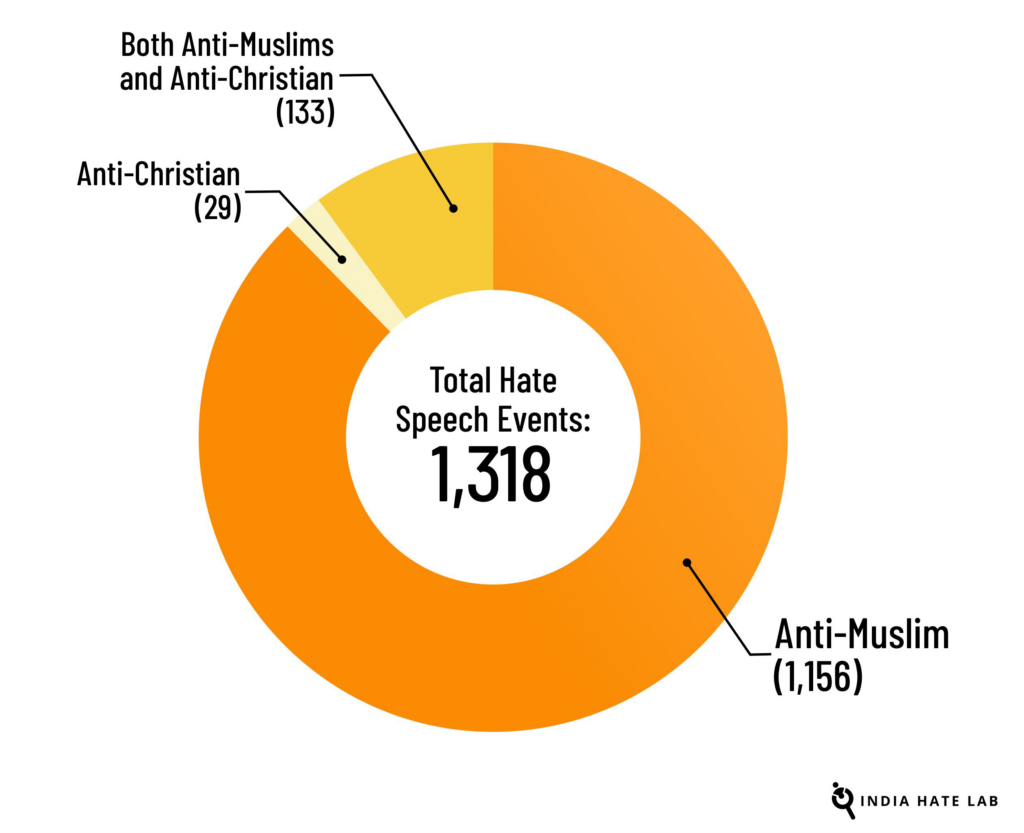
- Hate speech targeting Christians was recorded in 162 incidents, accounting for 12 percent of all events, either explicitly in 29 cases or alongside Muslims in 133 cases. This represents a nearly 41 percent increase from the 115 anti-Christian hate speech incidents documented in 2024.
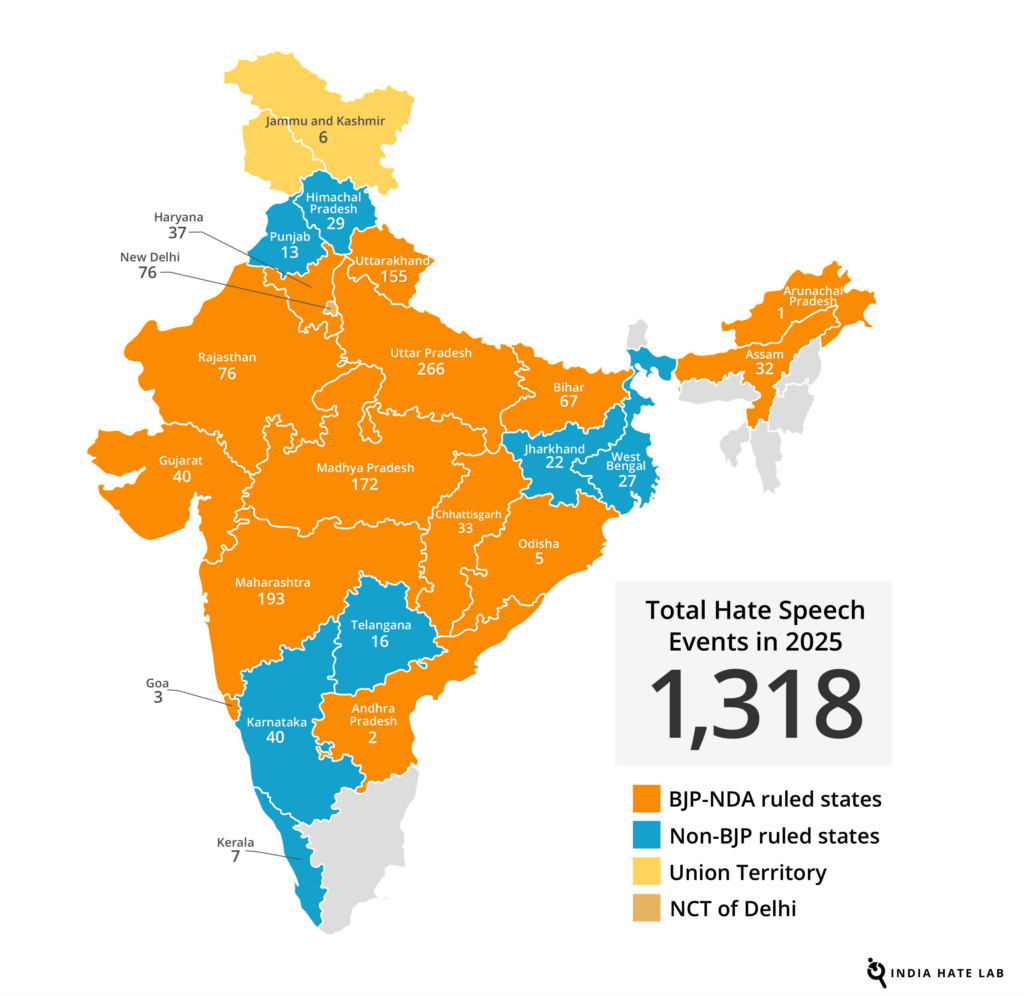
- Uttar Pradesh (266), Maharashtra (193), Madhya Pradesh (172), Uttarakhand (155), and Delhi (76) recorded the highest number of hate speech events. Across the 23 states and Union Territories analyzed, the BJP held power, either independently or as part of a coalition, in 16 jurisdictions for most of the year.
- 1,164 hate speech incidents (88 percent) occurred in states governed by the BJP, either directly or with coalition partners, as well as in BJP-administered Union Territories, reflecting a 25 percent increase from the 931 incidents recorded in 2024.
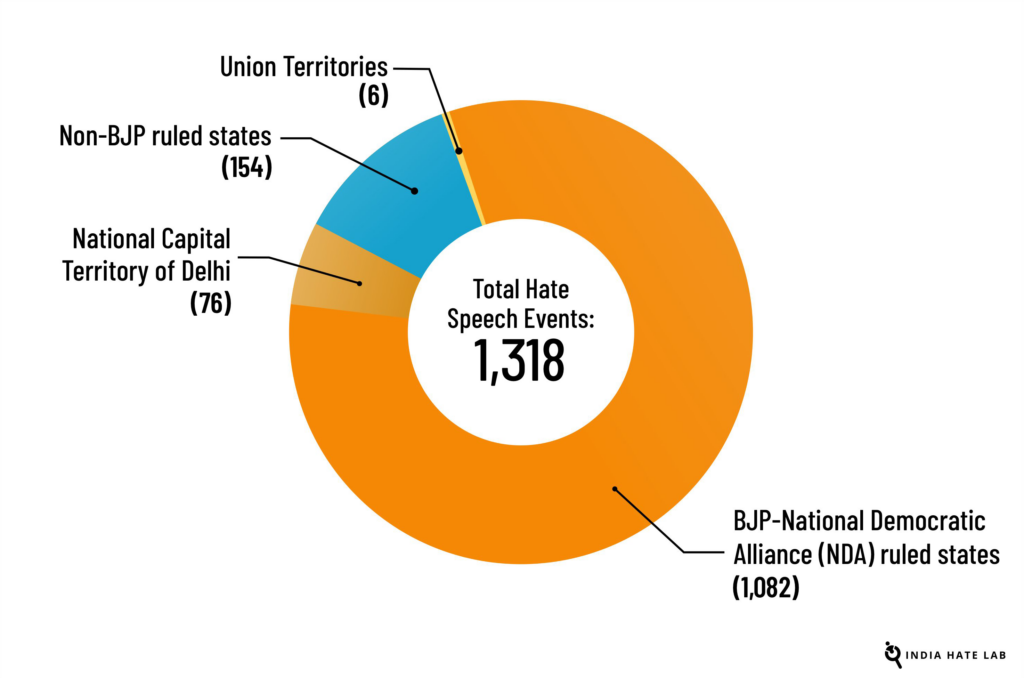
- Seven opposition-ruled states recorded 154 hate speech events in 2025, a 34 percent decrease from the 234 incidents documented in these states in 2024.
- April recorded the highest monthly spike, with 158 hate speech events coinciding with Ram Navami processions and hate rallies organized in response to the Pahalgam terror attack.
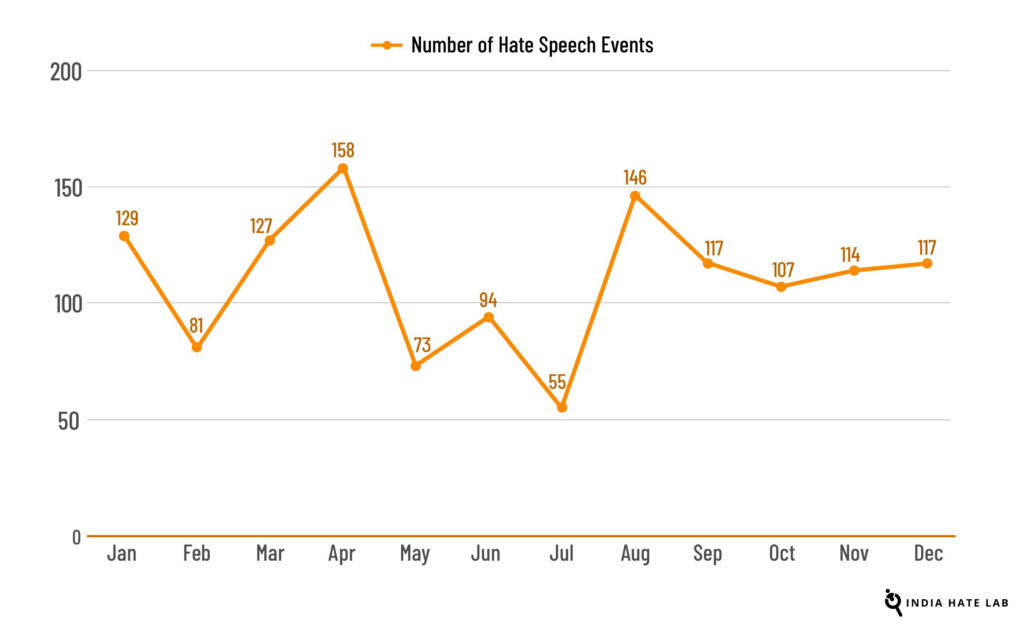
- In the 16-day period between April 22 and May 7, following the Pahalgam attack and preceding active hostilities between India and Pakistan, 98 in-person hate speech events were documented, indicating rapid and nationwide anti-Muslim mobilization.
- 656 hate speeches (nearly 50 percent) referenced conspiracy theories, including “love jihad,” “land jihad,” “population jihad,” “thook (spit) jihad,” “education jihad,” “drug jihad,” and “vote jihad,” representing a 13 percent increase from the previous year.
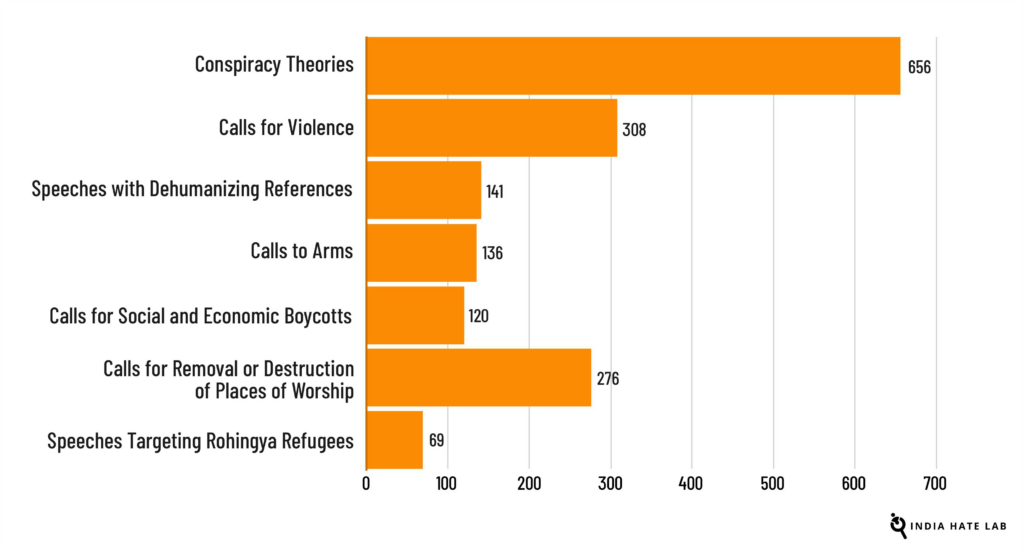
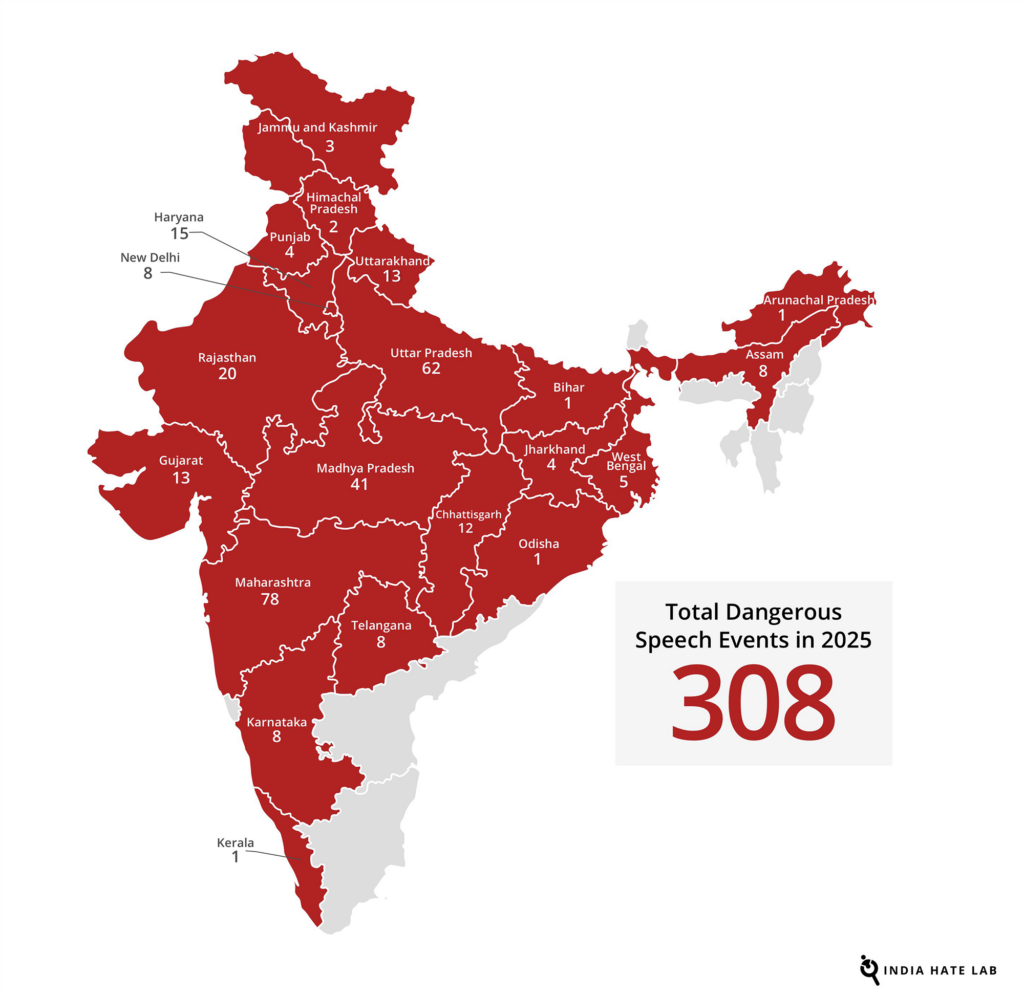
- 308 speeches (23 percent) contained explicit calls for violence, while 136 speeches included direct calls to arms.
- Maharashtra recorded the highest number of dangerous speeches, with 78 incidents, up from 64 in 2024. Nearly 40 percent of the state’s 193 hate speech events involved explicit calls for violence, the highest proportion recorded for any state.
- Among individuals delivering the most dangerous speeches, Maharashtra minister Nitesh Rane ranked among the top five actors issuing calls to violence.
- 120 hate speeches explicitly called for social or economic boycotts of minority communities, primarily Muslims, reflecting an 8 percent increase from 2024.
- 276 speeches called for the removal or destruction of places of worship, including mosques, shrines, and churches. The most frequently targeted sites in 2025 were the Gyanvapi Mosque and the Shahi Idgah Mosque in Uttar Pradesh.
- Dehumanizing language appeared in 141 speeches, with minorities described using terms such as “termites,” “parasites,” “insects,” “pigs,” “mad dogs,” “snakelings,” “green snakes,” and “bloodthirsty zombies.”
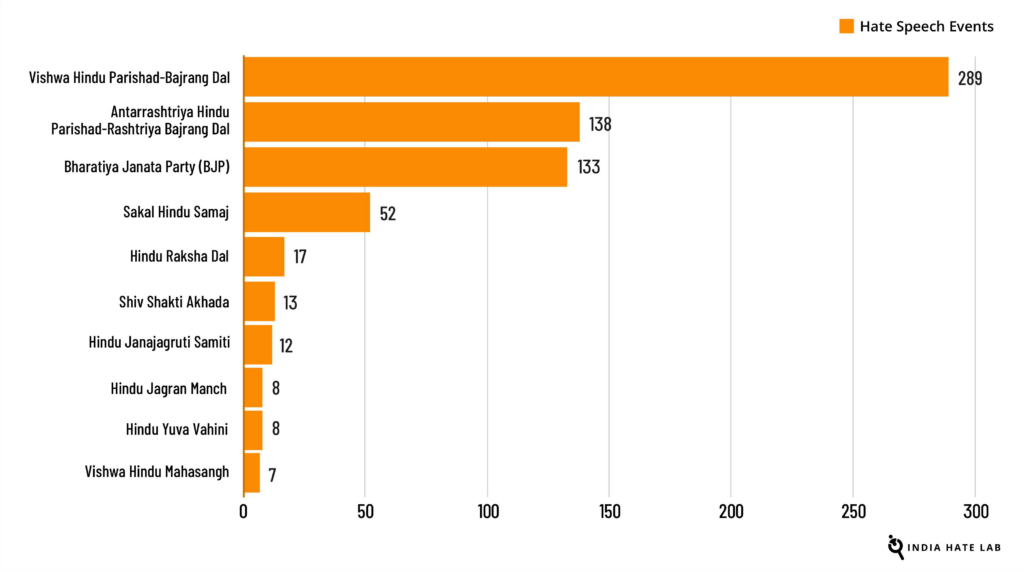
- Vishwa Hindu Parishad (VHP) and Bajrang Dal emerged as the most frequent organizers, linked to 289 hate speech events (22 percent), followed by Antarrashtriya Hindu Parishad (138 events). More than 160 organizations and informal groups were identified as organizers or co-organizers in 2025.
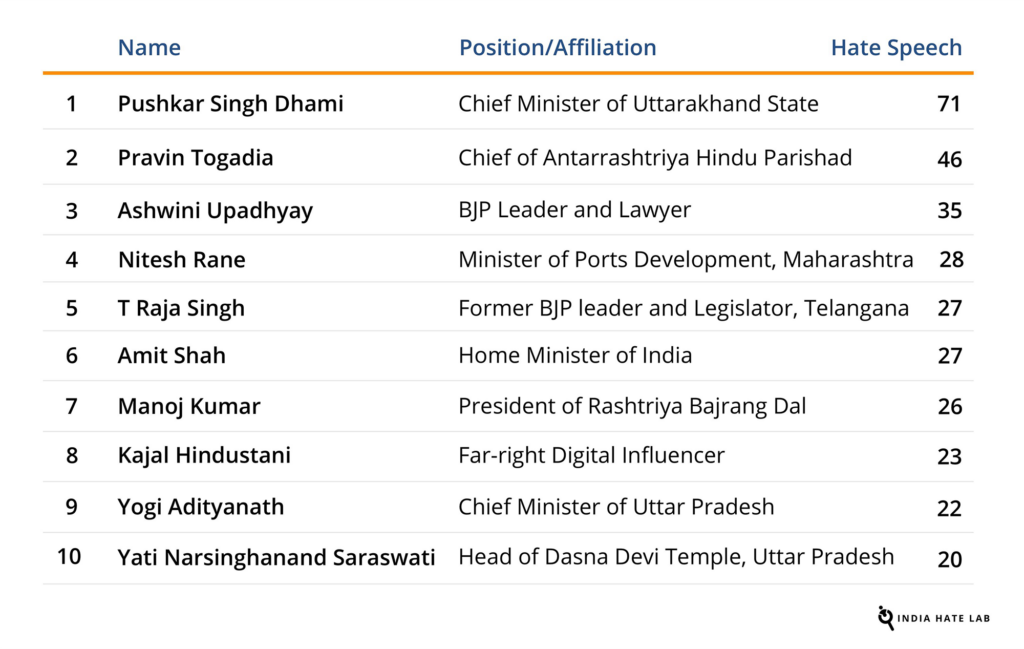
- Uttarakhand Chief Minister Pushkar Singh Dhami emerged as the most prolific hate-speech actor in 2025, with 71 speeches, followed by Antarrashtriya Hindu Parishad chief Pravin Togadia (46) and BJP leader Ashwini Upadhyay (35).
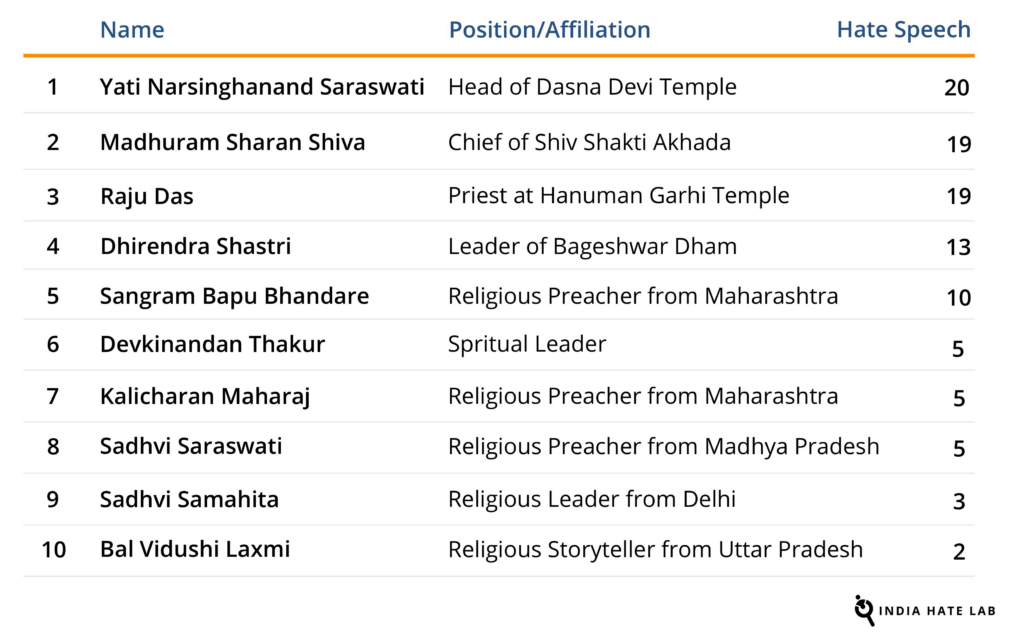
- Hindu monks and religious leaders were involved in 145 hate speech incidents, a 27 percent increase from 2024, continuing to provide religious legitimacy to anti-minority rhetoric.
- 69 hate speech events targeted Rohingya refugees, while 192 speeches invoked the “Bangladeshi infiltrator” trope, frequently used to stigmatize Bengali-origin Muslims as foreigners.
- Videos from 1,278 of the 1,318 hate speech events were first shared or live-streamed on social media platforms. Facebook accounted for 942 of the first uploads, followed by YouTube (246), Instagram (67), and X (23), highlighting the central role of social media in amplifying hate speech.
Hate Speech Events in India (2025)
Download the full report here: Hate Speech Events in India—Report 2025