
Since October 2024, India’s Uttar Pradesh state has witnessed the rapid emergence of an armed militant-monk movement led by Madhuram Sharan Shiva, who presents himself as a former full-time worker (pracharak) of the Rashtriya Swayamsevak Sangh (RSS) and former Prantiya Sangathan Mantri (Provincial Organization Minister) of the Vishwa Hindu Parishad (VHP). RSS remains the ideological and paramilitary backbone of the Hindu nationalist movement, while VHP functions as its militant affiliate.
Drawing on this background, Madhuram Sharan Shiva, who hails from Kora Jahanabad in Fatehpur district of Uttar Pradesh, has rebranded himself as a militant ascetic using religious authority to legitimise calls for mass mobilisation, communal hatred, and armed vigilantism.
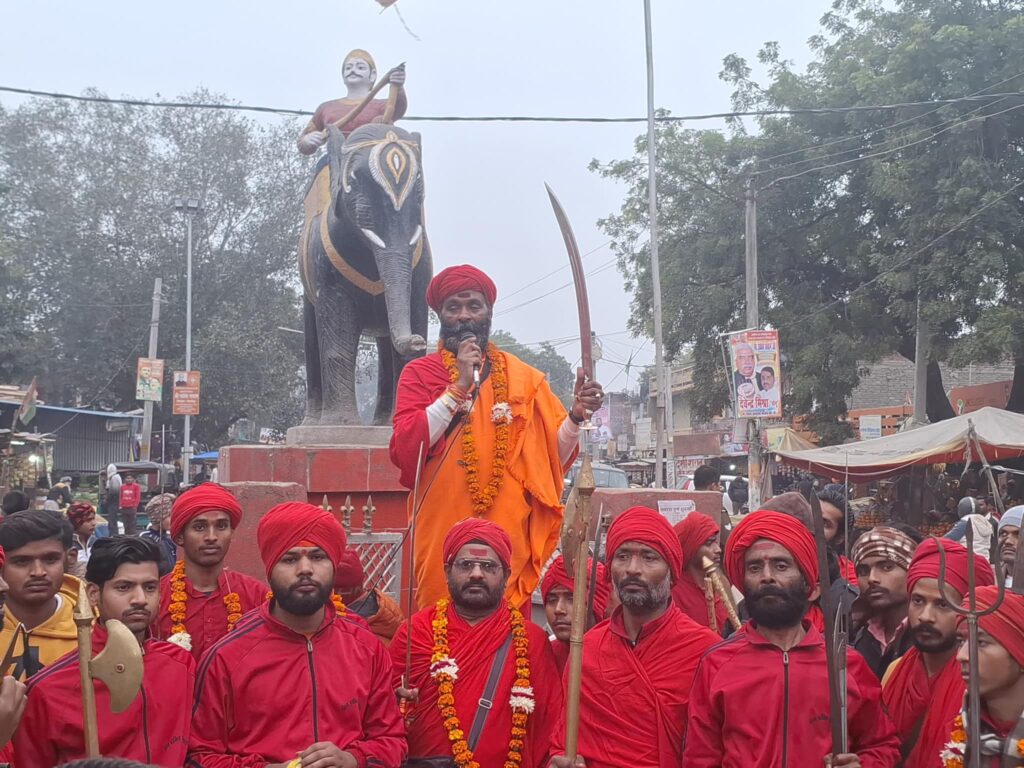
On October 22, 2024, he formally declared his monkhood and launched the “Shiv Shakti Akhada,” a group of armed monks who openly parade swords, guns, and other weapons.
Since then, he has organised at least 173 rallies across 11 districts of Uttar Pradesh, featuring repeated calls for violence, displays of firearms, communal incitement, and the public administering of hateful oaths, including to children and students, to take up arms against Muslims and Christians, whom he labels “vidharmis” and “adharmis.” Both vidharmi and adharmi are derogatory communal slurs used to dehumanize minorities as outsiders and enemies of the Hindu order.

The events consistently feature anti-Christian and anti-Muslim hate speech and direct incitement to arms and violence.
Across these rallies, Madhuram Sharan Shiva moves with dozens of armed monks, drawing crowds ranging from several hundred to thousands. His speeches rely heavily on inflammatory anecdotes designed to portray Hindus as endangered by Muslims. Citing a story about a doctor’s children allegedly running inside at the sight of Muslim men wearing skull caps, he argues that Hindus have “no option but to arm themselves,” framing weapons as essential for survival and for the establishment of a Hindu nation. His rhetoric often combines fear-mongering with explicit instructions to boycott Muslims, purchase weapons, and prepare for large-scale conflict.
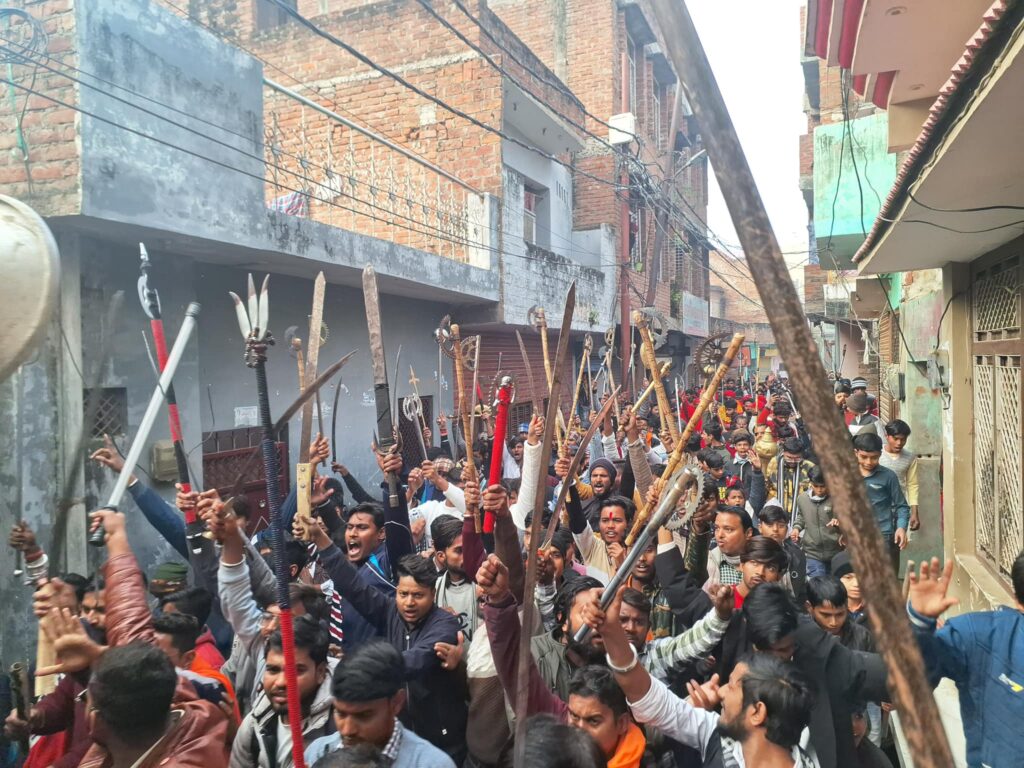
His speeches frequently cross the threshold of incitement. On November 9, 2024, in Farrukhabad, he invoked the slogan “Batenge toh Katenge,” adding, “We will not be divided; we will be the ones to cut.” On November 18, 2024, he claimed that “jihadis have occupied the market.” On December 18, 2024, he attacked Hindus, sending their children to Christian-run schools, labelling them “traitors” and insisting that Hindus must “pick up weapons to defend the country.” On April 23, 2025, in Samath Nagar, Jhansi, he invoked the Pahalgam terror attack to justify violence against Muslims, telling the crowd, “You have to finish these adharmis,” while urging them to prepare for war and cut economic ties with Muslim communities.
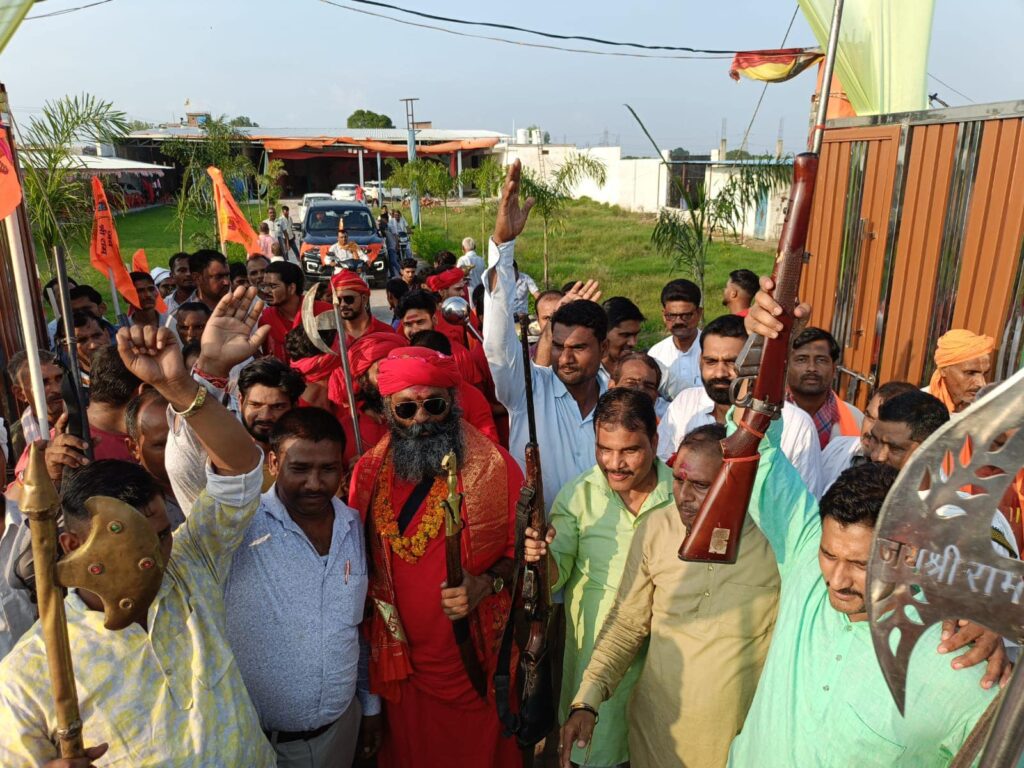
His May 3, 2025, rally in Jhansi targeted Hindus renting to or doing business with Muslims, calling them “enemies of their religion and nation.” On July 27, 2025, in Kanpur, he again branded as “traitors” those sending children to Christian schools. In Hamirpur on August 8, 2025, he led chants for a Hindu nation and warned that “blood will spill on the roads” if Hindu interests were challenged.
He consistently opposes slogans of communal harmony such as “Jai Bhim-Jai Meem,” portraying Dalit–Muslim solidarity as an existential threat and falsely claiming that Muslims seek to establish an Islamic State in India. He frequently asserts that “one who eats cow and one who rears a cow can never be brothers,” coupling dehumanising language with calls for armed defence.
Alarmingly, these rallies often occur in the presence, sometimes under the protection of police.
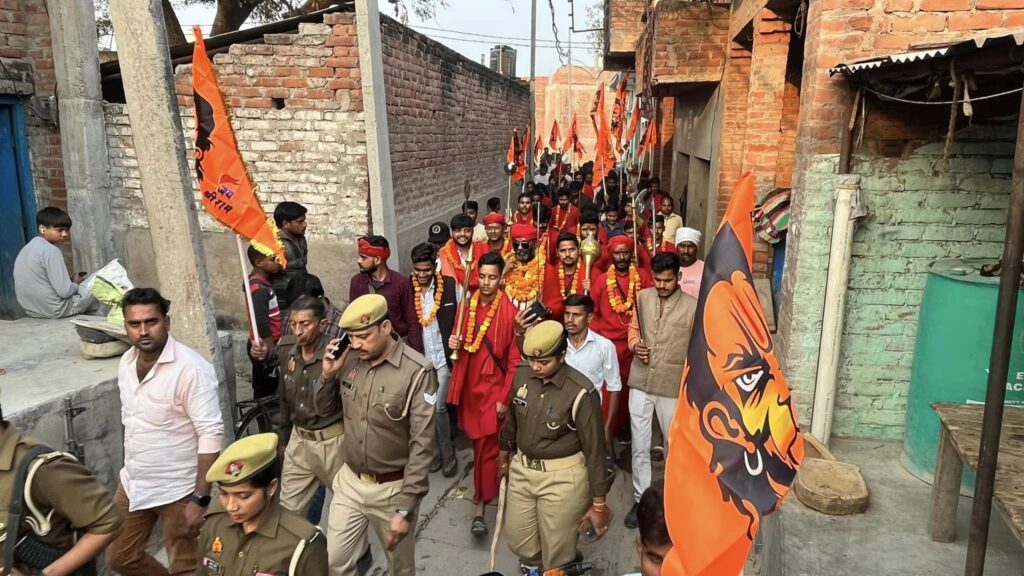
On September 6, 2025, in Kanpur, he was openly felicitated by two police officers.
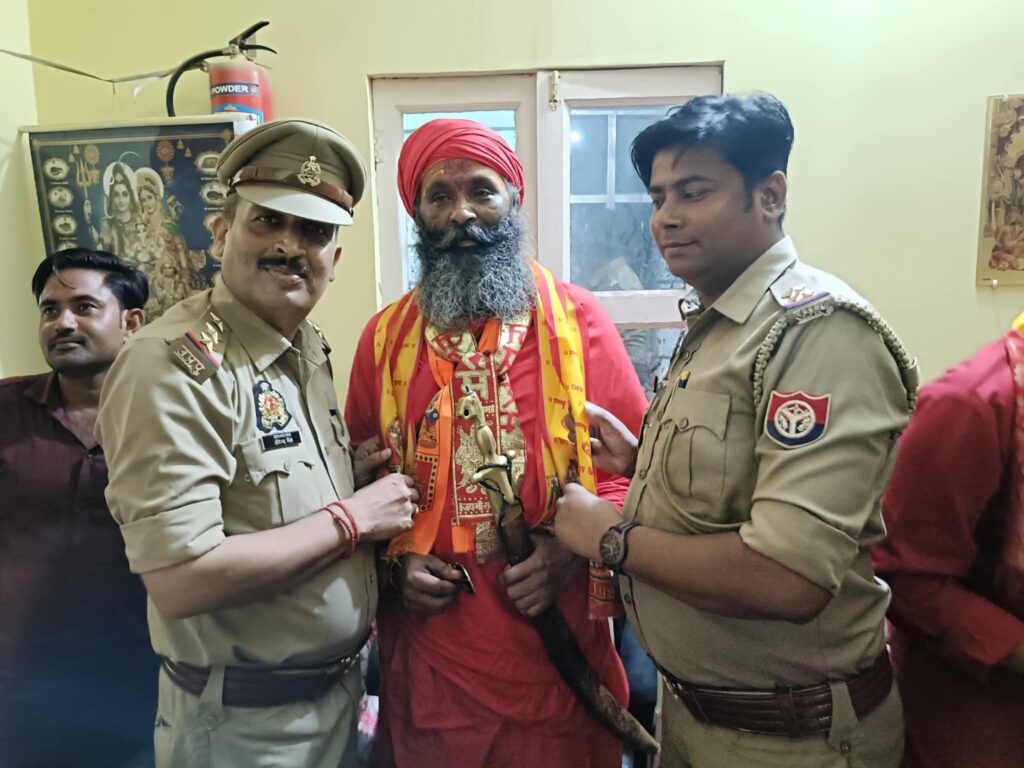
At a Ramlila programme in Umaran village, Kannauj, on October 25, 2025, he urged young Hindus to arm themselves while the Station House Officer of Tathiya Police Station, Jai Prakash Sharma, stood on stage. The presence and participation of law enforcement officials at such events signal institutional complicity and effectively normalise calls for violence.
Beyond the activities of the Shiv Shakti Akhada, Madhuram Sharan Shiva has leveraged religious and cultural gatherings as additional platforms for radicalisation. At a Ramleela celebration in Kanpur on October 4, 2025, he questioned whether youth would “kill jihadis” and “behead those who commit atrocities,” likening his targets to demons. Jihadi is used pejoratively as an anti-Muslim slur, intended to pigeonhole Muslims as inherently violent or extremist.
At the Akhil Bhartiya Kavya Samaroh in Rajepur on October 14, 2025, he demanded “Dashrath-like” (invoking the mythological king Dashratha) Hindus who would send their sons to “pick up arms and kill jihadis,” while fellow monk Mahant Raju Das simultaneously incited violence against those who opposed Sanatan. On October 28 in Bundelkhand, he accused Christian missionaries and Muslim groups of conspiring to divide Hindu society, describing both as “rakshas” (demons). He has also been observed participating in RSS morning sessions and conducting weapons training for young recruits, blending paramilitary activity with religious mobilisation.
Madhuram Sharan Shiva actively promotes his rallies and livestreams his hate speeches and armed processions through his social media channels. His primary Facebook account, followed by more than 29,000 users, regularly broadcasts these events, while his Instagram account, with over 6,400 followers, amplifies the same violent content.
Taken together, these developments represent a clear, escalating pattern of armed mobilisation, vigilante training, and coordinated hate speech targeting Muslims and Christians. The frequency of rallies, the systematic administration of violent oaths, the public display of weapons, and the presence of minors signal an intentional effort to cultivate a mass base for near-future violence. The presence and apparent endorsement of police officials further heighten the risk by signalling protection and impunity for those involved.
This situation constitutes an acute early-warning indicator of potential mass violence against minority communities in Uttar Pradesh. The combination of armed mobilisation, hate speech, dehumanisation, and institutional tolerance requires urgent intervention. The state authorities in Uttar Pradesh, the central government, the judiciary, the press, and the civil society must take immediate cognisance of this dangerous campaign, investigate the actors involved, halt the spread of armed vigilantism, and protect the rights and safety of minority communities before the situation escalates further.
This report is part of India Hate Lab’s Early Warning, Early Response (EWER) initiative. India Hate Lab is a project of the Center for the Study of Organized Hate (CSOH).
For media inquiries, contact: [email protected]